
Model Making

During the initial model-making session, the primary objective was to acquaint myself with various tools and materials. I engaged in the practical exercise of removing and attaching blades, followed by familiarizing myself with the utilization of scale rulers, operating at a 1:25 scale. In the process of crafting a box, a crucial lesson was to deduct the material width from the overall measurement to ensure accurate length upon joining the two pieces. After successfully constructing the box and steel deck, our group collectively had the opportunity to position them on a simulated 'stage,' gauging scale and placement by incorporating human figures.
In the second model-making session, I crafted a functional door within a wall. Employing a variety of materials, I utilized a scalpel to cut out distinct levels of the door, subsequently layering them together with PVA glue. To enable movement, masking tape was inserted between the layers, serving as a hinge. Additionally, layers were employed to fashion the door frame. Following the construction of the door, I arranged a scene using the boxes and steel decks previously created. In a subsequent session, I applied the skills honed with the door to install a window as well.
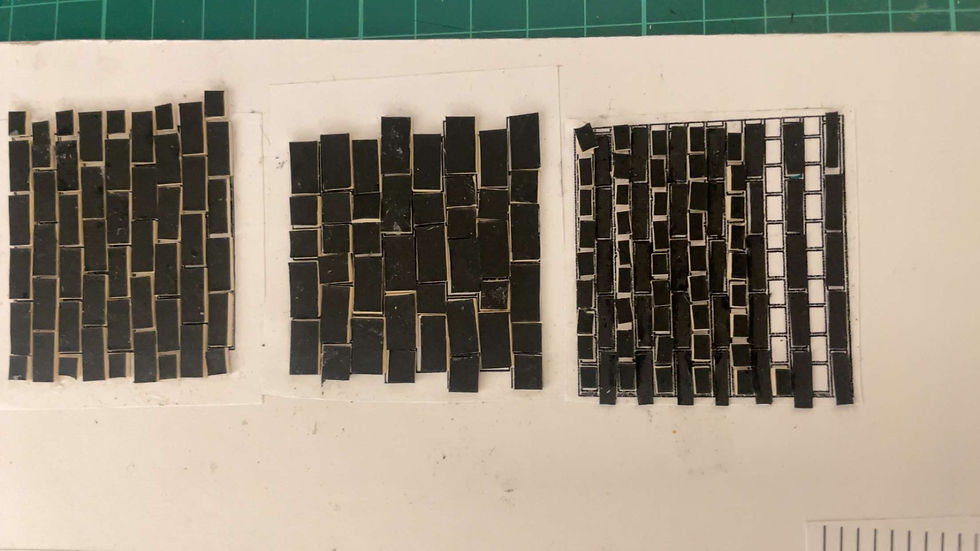
In the following model-making session, the focus shifted to incorporating textures onto our walls. Initially, we explored brick wall and cobblestone textures (though not to scale). The brick wall texture was achieved entirely on mountboard, ensuring uniform brick sizes. For the cobblestone texture, a mix of mountboard and ticket card was employed, introducing variations in brick thickness. Paint was applied to enhance the walls' dimensionality. Subsequently, we advanced to creating scaled-down bricks, demanding greater precision due to the smaller size of the pieces. Once again, a combination of thicknesses was utilized in this process.
Comments