
Construct The moment

Updated: Jan 13, 2025
In this Project, we delve into the fundamental aspects of stagecraft, focusing on key areas such as set construction, scenic painting, scenic dressing, and lighting. This multifaceted approach is designed to provide a comprehensive understanding of the collaborative nature of creating a stage production.
Set Construction
Set construction forms the backbone of any theatrical production. It involves building the physical structures that create the visual environment on stage. This aspect of stagecraft requires knowledge of:
Materials: Understanding different types of wood, metal, and other construction materials.
Tools and Machinery: Safe and effective use of saws, drills, hammers, and other construction tools.
Blueprints and Designs: Reading and interpreting design plans to build accurate and functional set pieces.
Structural Integrity: Ensuring that all constructed elements are safe and stable for actors and crew.
Scenic Painting
Scenic painting transforms the constructed set into a visually compelling environment. This craft involves:
Colour Theory: Understanding how colours interact and affect the mood of a scene.
Textures and Techniques: Using various painting techniques to create realistic textures like brick, wood grain, or stone.
Scale and Perspective: Creating illusions of depth and distance on flat surfaces.
Safety Practices: Proper ventilation and use of non-toxic paints and materials.
Scenic Dressing
Scenic dressing involves adding the finishing touches to the set, ensuring it looks lived-in and realistic. This includes:
Props and Furnishings: Selecting and placing furniture, props, and other items that enhance the setting.
Attention to Detail: Ensuring that every element on stage aligns with the director's vision and the period of the play.
Maintenance: Keeping the set in good condition throughout the run of the production.
Lighting
Lighting design is crucial for setting the tone, mood, and focus of a scene. Key principles include:
Lighting Equipment: Understanding the types of lights (e.g., spotlights, floodlights, LEDs) and their uses.
Color and Intensity: Using gels and dimmers to create the desired atmosphere.
Angles and Shadows: Positioning lights to highlight actors and set pieces while creating depth and dimension.
Safety: Handling electrical equipment safely and ensuring all lighting fixtures are securely mounted.
Collaboration and Practical Application
Throughout this course, we will collaborate closely, leveraging each other's strengths and insights to bring our designs to life. This collaborative process will involve:
Research and Design: Conducting thorough research to inform our designs and create accurate scale models.
Industry Guidance: Engaging with industry professionals who will offer mentorship and share their expertise, guiding us through the construction and design processes.
Terminology and Safe Practices
To ensure a successful and safe production, we will familiarize ourselves with the essential terminology and principles of stagecraft, including:
Safety Protocols: Adhering to safety guidelines when working with tools, machinery, and materials.
Communication: Using clear and precise language to coordinate with team members and industry professionals.
Problem-Solving: Developing strategies to overcome challenges that arise during the construction and design phases.
By the end of this course, we will have a solid foundation in the core scenic crafts and technical areas, equipped with the knowledge and skills to contribute effectively to any theatrical production.
research and scale modelling
Our first task of the project was to make a scale model of a location within the Waverley building. each of use made our own using precise measurements we took ourselves. I decided to reconstruct a potion of the Workshop room we also made a detailed technical illustration of our location/model using Auto Cad.
Why I Chose This Space.
1. I chose this Space in the Workshop as it gave me Enjoyment and relaxation when creating it, using this space reflected my interests.
2. The Space looks simple however when creating this it was extremely difficult to get the proportions of the belt sanders which gave it a bit of a challenge
3. The set is from the Waverly workshop I chose this as it is the room I have had most attachment in throughout my first year and I always love creating new products and set pieces
Initial Set Construction
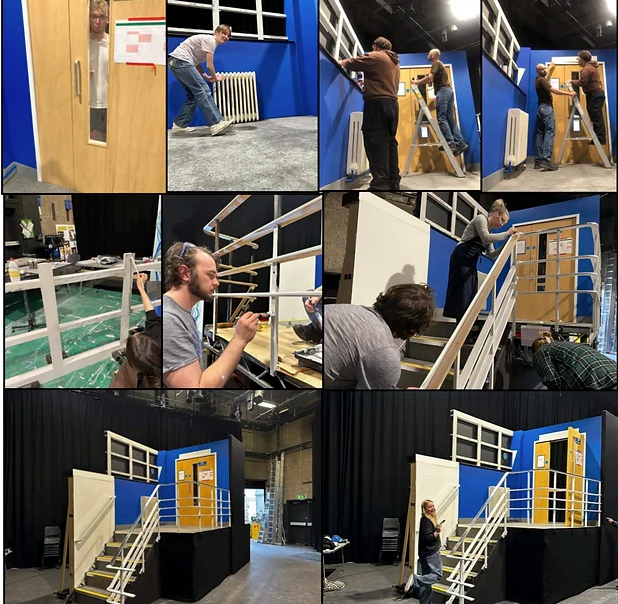
With our set chosen, our teams decided, and our technical drawing completed for reference, we began construction. Our first challenge was erecting the stairs and stage floor. For safety and practical reasons, we had to use industry-standard premade stairs and stage rostrum. This necessitated conforming to the dimensions of these premade assets, rendering our initial measurements inaccurate.
For the base construction materials, we used pine timbers, MDF of various thicknesses, and plywood. All materials were painted and assembled using screws and nails.

Later Set Construction and Detailing
With the essential base components fabricated and assembled, we moved on to applying decorative textures, props, and fittings. This process included weathering and other surface treatments, metallic veneers created using aluminum tape, a replica radiator, and signs and leaflets made from MDF and paper, respectively.
Projection and Lighting
With our stage completed and ready for use, we began devising a basic setting and story for a performance. We attended lectures and workshops on basic stage lighting and projection techniques. A BP screen (back projection) was mounted in the stage window to project a sky time-lapse, signaling the passage of time. We used lighting and projection to convey the place and atmosphere of our performance.
I was head of lighting a projection and Amy assisted me and explained what she imagined for the set. Having a solid story line meant we were easily able to queue lighting alongside the movement in the performance. As we have a window we took to opportunity to project an outside view from the window to make it realistic. The Skye line was recorded by Isaac in time lapse to show time passing by, which adds to the comical aspect of the characters in the performance waiting so long to seek medical attention.

Rehearsals and Performance
We decided to utilize the clinical appearance of our stage by setting our performance in a hospital A&E. This served as a commentary on the long waiting times and poor patient prioritization currently plaguing our overwhelmed, underfunded NHS. The three-minute performance featured no major dialogue, relying instead on lighting, projection, sound design, their transitions, and contextual clues to tell the story.

Project roles
Amy Sharp: Project manager, designer, Writer, director, Scenic artist, sound
Josh Ashwell: Project manager assistant, designer and props
Isaac Walkinshaw: Construction, Lighting and projection and Assembly
Johnty North: Construction
Amber Minton-Westhead: construction and scenic painter
Jinah Kim: Scenic painter


Comments